
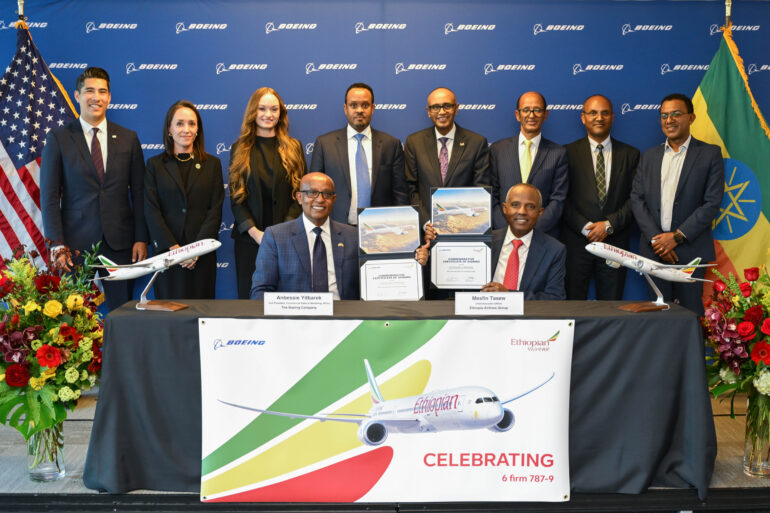
On April 21, 2026, in Addis Ababa, Ethiopian Airlines and Boeing confirmed what the industry had been watching for: the airline formally converted six previously held options into firm orders for Boeing 787-9 Dreamliner aircraft, completing a commitment that traces back to a landmark deal signed in 2023.
It is the kind of announcement that, on the surface, reads like routine fleet management. Look closer, and it is anything but.
Africa’s Biggest Bet on Long-Haul Travel
Ethiopian Airlines already operates Af0rica’s largest Boeing 787 Dreamliner fleet. Its 787-8 and 787-9 jets connect Addis Ababa to high-demand destinations across Europe, Asia and North America, as well as key intra-African routes that stitch together a continent still building its own aviation backbone.
The six new 787-9s are earmarked for two purposes: expanding the airline’s intercontinental network and increasing cargo capacity on routes where demand is outpacing supply. Both objectives speak to an airline that is not simply growing but deliberately positioning itself as the aviation gateway for an entire continent.
Ethiopian Airlines Group CEO Mesfin Tasew did not understate the moment. “Converting the options of six Boeing 787-9 Dreamliner airplanes into a firm order is truly a proud moment for us,” he said. “The order shows Ethiopian Airlines’ sustainable growth and preparation for further achievements. Growing our fleet size with ultra-modern airplanes such as the Boeing 787-9 Dreamliner, we are further maintaining operational excellence and passenger comfort.”
Why the 787 Matters Beyond the Specs
The Boeing 787 Dreamliner is not merely a popular aircraft. It is a specific kind of tool, built for a specific kind of ambition. Its composite construction and fuel-efficient engines make it roughly 25 percent more fuel-efficient than the older wide-body jets it replaces, allowing airlines to operate thinner long-haul routes profitably that would otherwise be unviable.
For a carrier like Ethiopian, which is connecting African cities to global markets while simultaneously managing the realities of thin margins and rising fuel costs, that efficiency is not a luxury. It is a competitive necessity.
The 787-9 variant, which Ethiopian has chosen for this order, seats more passengers and carries more cargo than the smaller 787-8, making it better suited to routes where demand justifies the additional capacity. Belly cargo, in particular, has become a meaningful revenue stream for Ethiopian as African exports, particularly perishables and cut flowers from the continent, move through Addis Ababa to global markets.
Boeing vice president of Commercial Sales and Marketing for Africa, Anbessie Yitbarek, framed it plainly. “We’re proud that Ethiopian Airlines continues to look to the 787 Dreamliner to serve as the backbone of their fleet as they grow and modernise their operations, open new routes and comfortably serve more passengers,” he said.
Eighty Years and Still Climbing
The timing of this announcement carries a particular resonance. Ethiopian Airlines is currently marking its 80th anniversary, a milestone that makes this order more than a procurement decision. It is a statement of intent from an airline that began flying in 1946 and has spent eight decades building what is now the most expansive aviation network on the African continent.
The airline currently reaches over 145 global destinations and operates a fleet of more than 170 aircraft with an average age of just seven years, one of the youngest in the world among carriers of comparable size. It has won the SKYTRAX Best Airline in Africa award for eight consecutive years and is a member of the Star Alliance global network.
That combination of scale, youth and connectivity is precisely what makes this Dreamliner order significant for travelers. New wide-body aircraft mean more seats on more routes, newer cabin interiors, improved fuel efficiency and, for passengers who care about it, a meaningfully lower carbon footprint per mile flown.
What this means for Travelers
For anyone planning long-haul travel through Africa in the next two to three years, the expansion of Ethiopian’s Dreamliner fleet signals something worth noting: more options, more frequency, and potentially more competitive pricing on routes where Ethiopian competes with European and Middle Eastern carriers for connecting traffic.
Addis Ababa’s Bole International Airport has increasingly positioned itself as a genuine hub for connecting flights between Africa, Asia, Europe and North America. Ethiopian’s investment in wide-body capacity suggests that strategy is not slowing down. If anything, it is accelerating.
For travelers in East Africa specifically, this matters. Every additional Dreamliner that Ethiopian puts into service adds connecting capacity through Addis Ababa, making it easier and potentially cheaper to reach long-haul destinations without routing through European or Gulf hubs.