
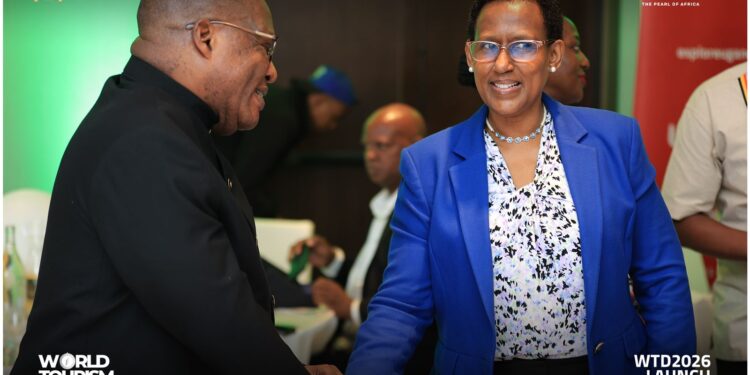
In a statement read on his behalf by the ministry’s permanent secretary, Doreen Katusiime, at a launch in Kampala, Butime said a destination’s visibility online was now directly tied to its competitiveness, because travellers increasingly discover, compare, book and review destinations digitally.
He said the year’s theme, “Digital Agenda and Artificial Intelligence to Redesign Tourism,” could not have been more timely, adding that technology should be treated as an enabler of growth rather than merely a communication tool. But he warned that smaller operators were lagging in digital adoption.
“I call upon those already benefiting from technology to hand-hold the weaker ones,” Butime said. “No tourism business should be left behind.”
The minister used the launch to release half-year figures. Uganda received 793,815 international visitors between January and June 2026, a 3.7% increase on the same period in 2025. Tourism receipts rose 25.6% to about 2.3 trillion shillings, and the average length of stay increased from 7.4 to 8.3 nights.
Butime said the figures showed tourism’s growing contribution to the economy but should prompt the sector to extract more value from each visitor through longer stays and wider spending. He also flagged a reported decline in national park visits as a reason not to become complacent, urging continued investment in marketing, product diversification and conservation.
The caution reflects a tougher market. Uganda faces strong competition from Kenya, Rwanda and Tanzania, and officials say only destinations offering something distinctive will keep attracting premium visitors — the reasoning behind the shift towards the country’s east.
A pivot to culture and community
The Uganda Tourism Board has been steadily rotating its annual celebrations away from wildlife parks towards local cultures. It marked last year’s event in the Greater Rwenzori region and toured Kasese two weeks before this launch, before settling on Mbale and the Elgon region.
The board’s chief executive, Juliana Kagwa, said she had begun her tenure 18 months earlier by visiting Mount Elgon and Sipi Falls, struck by how few people outside Uganda knew such places existed.
“We are now diving deep into the culture, heritage and providence of our people,” she said. “This is the time for the Bagisu and all the other communities living there to showcase everything that makes you special: your coffee, your initiation ceremonies, your food, everything.”
Kagwa said the sector would put its full weight behind the region. “This is your time to shine,” she told the Bagisu and other communities, “because with the full backing of social and traditional media, we are bringing the power and might of the sector to shine a light on all things Bugisu.”
Why Mbale
Butime said the choice of Mbale was deliberate, describing the city as the gateway to the Elgon tourism region, with attractions including Wanale Hills, Sipi Falls, Mount Elgon National Park, Sisiyi Falls and coffee tourism. A campaign dubbed Explore Uganda – Masaba Edition will take media, influencers and operators to experience the region.
Issa Kato, vice-president of the Uganda Tourism Association, said online tools now shape decisions before a traveller commits. “Before a guest even chooses Uganda, the internet and AI are already guiding their choices,” he said.
To build domestic interest, officials said Ugandans would be granted free access to eight national parks from 25 to 27 September, with media influencers helping to amplify the campaign. President Yoweri Museveni is expected to attend the main celebrations in Mbale.
Butime called on government agencies, local governments, businesses, the media and communities to take part in the month-long programme, urging them not merely to attend but to promote and support the events.